Distributed Automation Pipeline
Visual workflow orchestration with real-time run observability and deterministic fault handling.
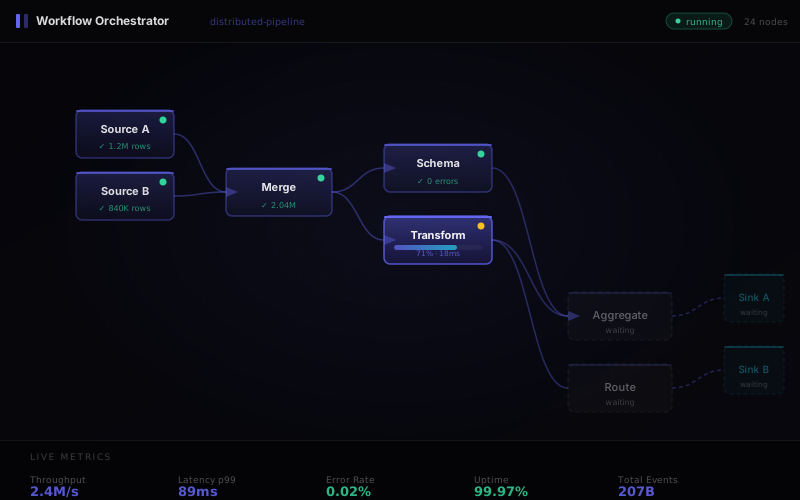
A production-grade workflow engine where operators design execution graphs visually, monitor distributed runs in real time, and debug failures with event-level tracing.
Problem Space
Multi-step automation across distributed services generates opaque failure chains. Retries lack coordination, execution state is invisible, and debugging requires reconstructing event sequences from scattered logs.
System Design
A visual workflow engine with real-time run timelines, per-node metrics, structured error handling, and event-level tracing. Operators design execution graphs visually, run them deterministically, and diagnose failures with full context.
System Components
Live Prototype
Interactive prototype — all data generated client-side with deterministic seeds.
Reference Performance
Reference benchmark: 6-node pipeline, 80 evt/s baseline with burst to 1,200 evt/s at t=30s. Measured throughput, p95 latency, and error rate over 60s window with deterministic seed.
Deterministic seed · 60s window · Simulated workload · Local environment